
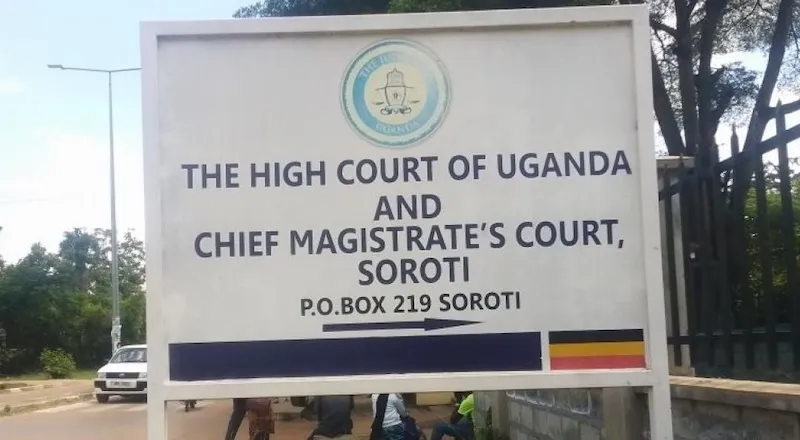
Two Egyptian nationals have been sentenced to 22 years in prison after admitting to the murder of their colleague in Soroti, eastern Uganda.
The High Court in Soroti convicted Muhamed Nabil Mohammed Ali Shokr and Fahim Abdlhalim Abbas Badawy over the killing of Mahmoud Ahmed Zinhom Ibrahim Selim, a businessman dealing in kitchenware, whose body was later dumped beneath Awoja Bridge following the attack in February 2024.
Justice Boniface Wamala sentenced each of the two men to 22 years in jail but ordered that the two years and four months they had already spent on remand be deducted from their sentence.
“Having prayed for leniency and for forgiveness, each of you has been sentenced to 22 years. Upon deduction of the two years and four months spent on remand, each will serve 19 years, seven months and two days,” the judge ruled.
Court proceedings heard that the accused were among four people initially charged in connection with the killing. The others were Mahamed Mahmoud Ahmed, also known as Shank, and Mohamood Ahmed.
According to the prosecution, Shokr, Badawy and Shank travelled to Selim’s home in a Pajero vehicle belonging to Mohamood Ahmed. Before leaving for his trip, Selim had informed his neighbour, Mark Wilson Kisolo, that friends would visit his home and asked him to allow them access.
While Selim was returning to Soroti, Shank contacted him to establish his whereabouts before briefly leaving the residence to repair a punctured tyre. On returning about an hour later, he found Selim lying in a pool of blood.
Evidence presented in court indicated that Badawy allegedly struck Selim with an iron bar during a fight.
Prosecutors said the two convicted men wrapped the victim’s body in a blanket and instructed Shank to open the boot of the vehicle, claiming they were taking him to hospital.
Instead, the trio drove to Awoja Bridge, where the body was thrown into the river during the night. Shank later told the court that he had been threatened with a knife and forced to drive to the scene.
Neighbours reported Selim missing after he failed to return, prompting police investigations. Detectives later arrested Shank, who led them to the bridge where Selim’s body was recovered nine days after the killing. His cooperation helped investigators arrest the remaining suspects.
During the trial, Shank pleaded guilty to his role in the incident. The prosecution subsequently withdrew the murder charge against him and instead charged him as an accessory after the fact to murder.
Justice Wamala accepted his plea, citing his cooperation with investigators, his status as a first-time offender and his prospects for rehabilitation. Taking into account the time already spent on remand, the court discharged him on the amended charge, after which he testified as the prosecution’s principal witness.
Following his testimony, Shokr and Badawy also admitted responsibility for the killing and pleaded guilty, asking the court for forgiveness.
The prosecution argued that the pair unlawfully caused Selim’s death before attempting to conceal the crime by cleaning the scene and disposing of the body, urging the court to impose a 25-year prison sentence.
Defence lawyer Francis Ajuun appealed for a lighter sentence, arguing that both men were first-time offenders who had pleaded guilty and saved the court’s time. He also asked the court to consider the period they had already spent in custody.
In delivering judgment, Justice Wamala described the offence as serious and violent, saying it deserved a deterrent sentence.
Meanwhile, the court granted Mohamood Ahmed a non-cash bail of Shs5 million after finding insufficient evidence to keep him on the murder charge. His case was adjourned until 17 August 2026.
